
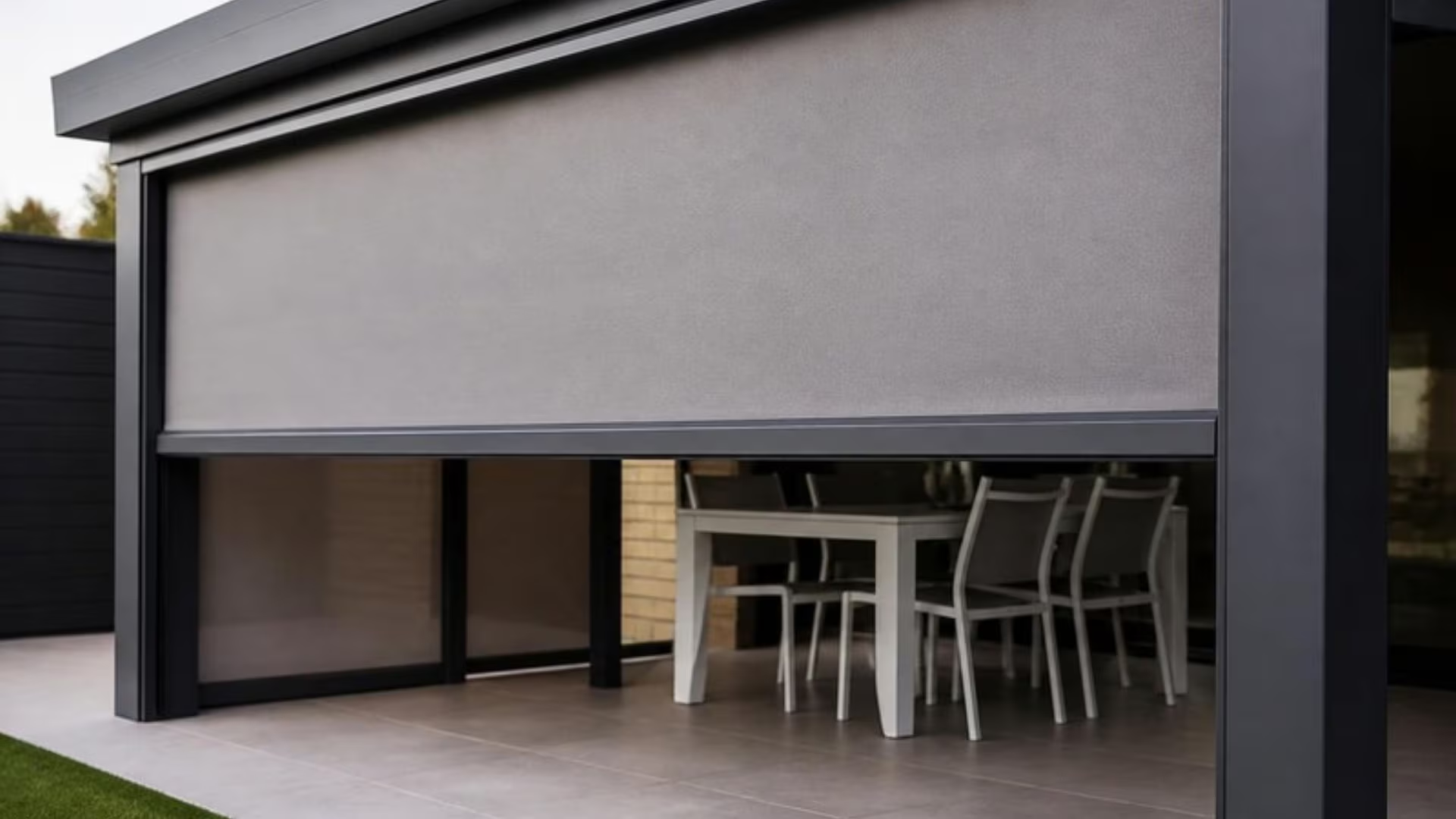
External blinds & zip screens
Shade on the outside of the glass, where it stops the heat before it gets in. Tilt the slats or lower the screen and keep the view.
What are external blinds?
External blinds are sun blinds fitted on the outside of a window or glazed door. Because they stop sunlight before it reaches the glass, they keep far more heat out than any blind hung inside the room, which only catches the heat once it’s already in.
There are two main types. External venetian blinds, also called facade blinds, have horizontal aluminium slats you can tilt to control light and privacy. Zip screen blinds are fabric roller blinds whose edges are held in the side guides by a zip-like strip, so the fabric stays taut and doesn’t flap in the wind.
External blinds at a glance
- Types: External venetian (facade) blinds and zip screen blinds
- Venetian slats: Powder-coated aluminium, tilting to let in as much or as little light as you want
- Zip screen fabric: Screen fabrics you can see out through, or blackout
- Control: Manual crank, or motorised with a wall switch, remote, timer or app
- Sensors: Optional sun and wind sensors that lower and raise them automatically
- Mounting: On the wall face, in the window reveal, or with the box hidden above new windows
Venetian blinds, zip screens or roller shutters?
All three go on the outside of the glass. They do different jobs, so the right choice depends on the room.
| External venetian blinds | Zip screens | Roller shutters | |
|---|---|---|---|
| Daylight when closed | Adjustable: tilt the slats | Softened. You can see out through screen fabric | None: full blackout |
| Keeping out summer heat | Very good | Very good | Very good |
| Wind | Raised automatically in strong wind | Good. The fabric is held in its guides | Very good |
| Security | Low | Low | High |
| Best for | Home offices, big south and west windows, glazed gables | Patio doors, glass extensions, pergolas and verandas | Bedrooms, security, holiday homes: see electric roller shutters |
Why shade the outside of the glass?
Modern Irish homes are better insulated and more airtight than ever, and many have large areas of south or west-facing glass. On a sunny day that glass lets in a lot of heat that has nowhere to go, and rooms overheat even in spring and autumn. An internal blind stops the glare but most of the heat is already inside. An external blind stops it at the source, so the room stays cooler without air conditioning.
They also cut glare on screens, add privacy in the evening and, with blackout fabric, darken a bedroom fully.
Irish wind and weather
Wind is the first question we get, and it’s a fair one. External venetian blinds are the more delicate of the two: on exposed or coastal sites we fit them with a wind sensor that raises them automatically when it gets too breezy. Zip screens cope with more wind because the fabric is locked into its side guides along the full height. Both are made from powder-coated aluminium and outdoor fabrics that don’t mind rain.
Fitting to an existing house or with new windows
Existing windows. The blind and its head box mount on the wall above the window or inside the reveal. Nothing about the window changes, and most fits take a few hours per opening.
New windows, new builds and insulation upgrades. The head box can sit above the new frame, hidden behind render or external insulation, so all you see from outside are the guides. This needs planning with the window order, which is why we like to hear about blinds early. See our uPVC windows and aluminium windows.
How we survey, supply and fit external blinds
- Survey. We measure each opening, check the wall above for fixings and cable routes, and look at how exposed the site is.
- Specification. We agree the type, colours, fabric or slat, controls and sensors, and you get it all in writing.
- Made to measure. Each blind is built to the surveyed size.
- Fitting. We fix the box and guides, set the limits and connect the motor. An electrician makes the final connection where needed.
- Handover. We show you the controls, the sensor settings and what to do if the power goes.
Typical uses for external blinds
- South and west-facing living rooms and kitchen extensions that overheat
- Home offices with glare on screens
- Glass rooms, verandas and pergolas that need shade and shelter from the wind
- Bedrooms where you want blackout without a roller shutter
More shutters & blinds
External blind FAQs
Do external blinds work in Irish wind?
Yes, with the right type and controls. Zip screens hold their fabric in the side guides and cope with more wind. External venetian blinds should be raised in strong wind, so on exposed sites we fit a wind sensor that does it for you automatically.
Can you see out through a zip screen?
Yes. Screen fabrics are woven so you can see out during the day while they block most of the sun’s heat and glare. If you want full darkness, choose a blackout fabric instead.
Can external blinds be added to an existing house?
Yes. On an existing house the head box fixes to the wall above the window or inside the reveal. We check the wall for fixings and the route for the motor cable at survey.
Do I need planning permission for external blinds?
At the back of a house it rarely comes up. Fitting them to the front of a protected structure or a house in an Architectural Conservation Area needs permission, and some councils take a view on visible boxes on front elevations. Ask your local council if you’re unsure, and see our planning permission guide.
What happens to motorised blinds in a power cut?
They stay where they are until the power comes back. Manual versions with a crank are available if you’d rather not depend on a motor.