
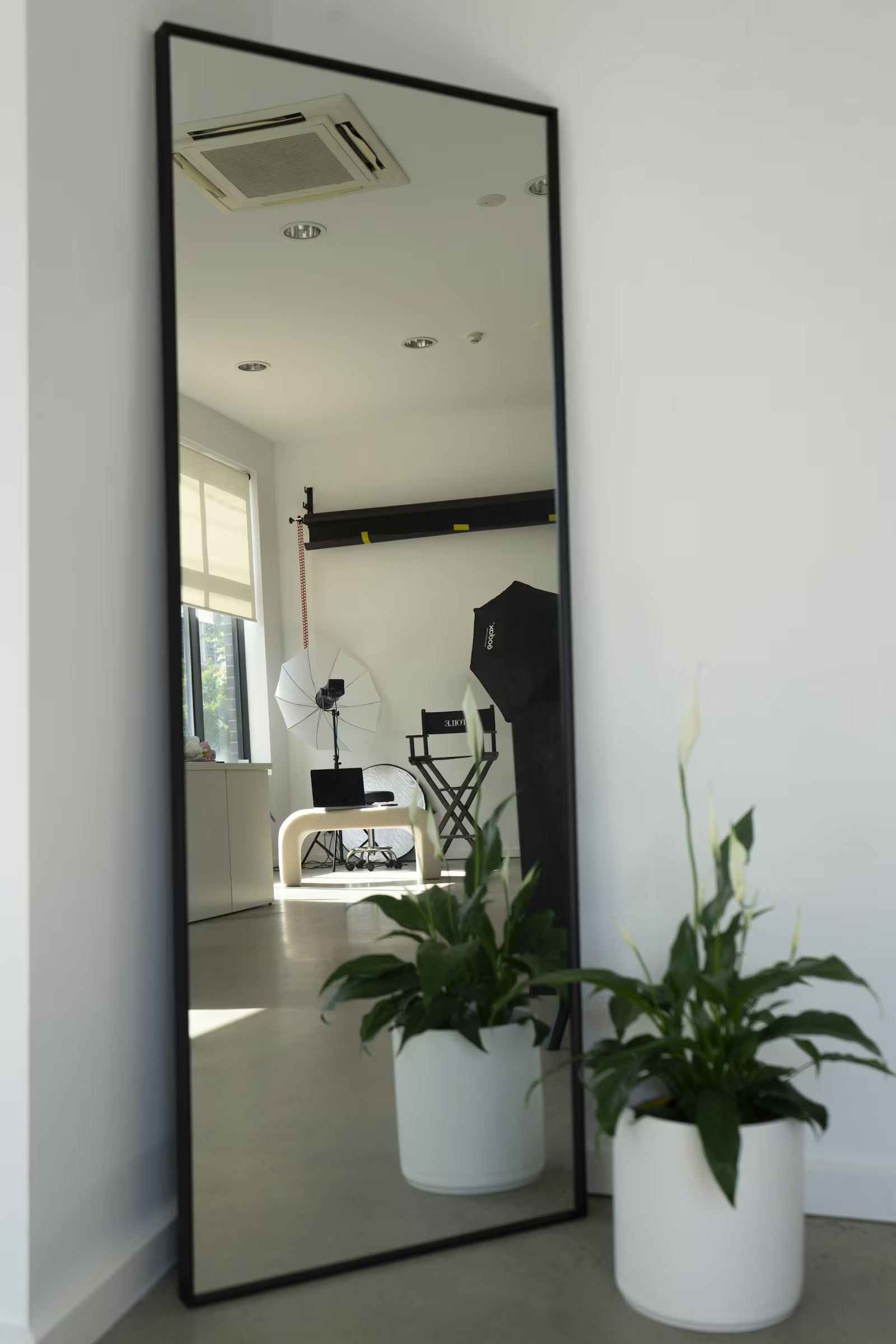
Mirror glass
Mirrors
Silver, low-iron, tinted, antique and safety-backed mirror, supplied in stock sheets or cut, edged and drilled to size.
Mirror types
All mirror types can be cut to rectangles, circles or shapes from your template, then finished with polished or bevelled edges and drilled for fixings.
Silver mirror
The standard reflective mirror on clear float glass. Modern copper-free silvering resists edge corrosion far better than older mirror, which matters in bathrooms and kitchens.
- Usually 4 or 6 mm
- Flat polished or bevelled edges
- Drilled for mirror screws or supplied for bonding
Low-iron mirror
Silvered on extra-clear glass for a colour-neutral reflection without the faint green cast of standard mirror. The best choice for large wall mirrors and feature pieces.
- Truer colours and skin tones
- Recommended for large or wall-to-wall mirrors
Tinted mirror
Bronze or grey mirror adds warmth or depth and softens reflections. Popular for feature walls, furniture and hospitality interiors.
- Bronze and grey tints
- Cut, polished and drilled like standard mirror
Antique mirror
Mirror with a deliberately aged, mottled finish for character interiors, bars and restaurants. Every sheet is slightly different, so we recommend approving a sample first.
- Light to heavy ageing effects
- Sample approval recommended
Safety-backed mirror
Mirror with a safety film on the back that holds fragments in place if it breaks. Specify it for wardrobe doors, gyms, schools and any mirror within reach of impact.
- Safety film impact-tested to EN 12600
- Essential for mirrored wardrobe doors
Mirror processing
Cut to size
Rectangles, circles, ovals and shapes cut from your drawing or template.
Edgework
Flat polished edges for a clean frameless look, or bevelled edges for a classic finish.
Holes & cut-outs
Drilled holes for mirror screws and cut-outs for sockets, switches and lighting.
Fixing advice
Guidance on mirror screws, clips and mirror-safe adhesives for your wall type.
Mirror questions
Practical advice on choosing, fixing and caring for mirror.
Why do mirror edges turn black?
Black edges are corrosion of the silver layer, usually caused by moisture, unsuitable adhesives or harsh cleaning products. Copper-free mirror, polished edges and a mirror-safe adhesive all reduce the risk.
Can a mirror be fixed directly to a bathroom wall?
Yes. Use copper-free mirror with polished edges and a neutral-cure adhesive made for mirrors, and keep acidic or ammonia-based cleaners away from the edges.
Which mirror thickness should I choose?
4 mm suits most framed and smaller bonded mirrors. 6 mm is stiffer and gives a flatter, less distorted reflection, so it is better for large wall mirrors and furniture.
Mirrors cut to size for homes and businesses
We supply mirrors cut to size for bathrooms, bedrooms, hallways, wardrobes, gyms, salons, hotels and shops. Every mirror is cut to your exact measurements, with polished or bevelled edges, holes for fixings and cut-outs for sockets where needed.
Choose silver mirror for everyday use, low-iron mirror for the truest colours, moisture-resistant mirror for bathrooms, or tinted and antique mirror for decorative walls. Add safety backing film to any mirror in a busy area.
For finished pieces, see our framed mirrors, LED mirrors and mirror wall cladding.
Planning a mirror?
Send the size, mirror type, edge finish and fixing method, and we will send back an itemised quote.