
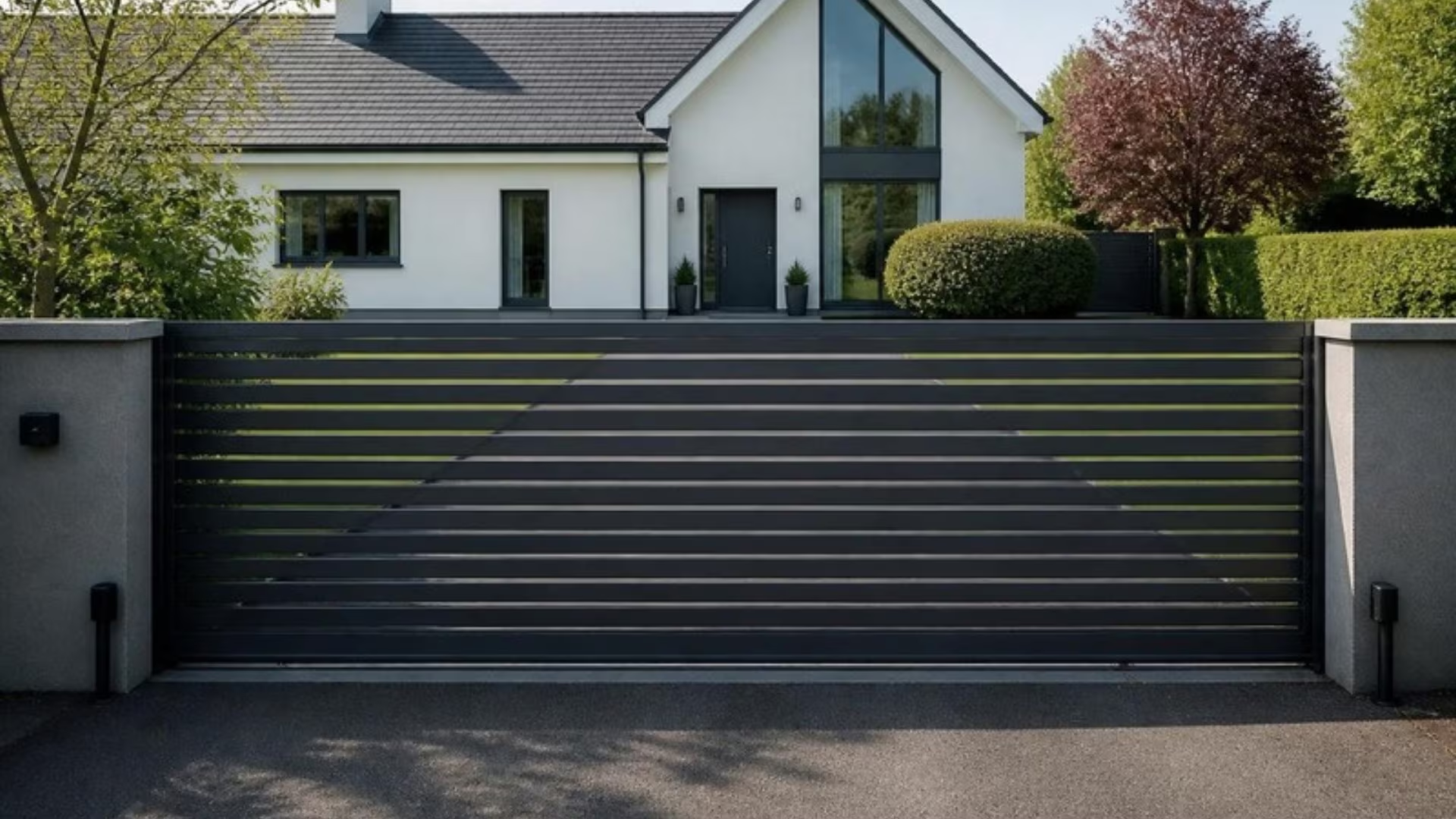
Electric sliding gates
Aluminium gates that slide across the entrance, with safe, quiet automation, ideal for short or sloping driveways.
What is an electric sliding gate?
An electric sliding gate is a single gate leaf that moves sideways across the entrance, driven by a motor that engages a rack along the gate. It runs on a track in the ground or, in a cantilever design, is carried on rollers at one side with no track across the opening. Because it never swings, it needs no space on the drive. That makes it the natural choice for short driveways and for drives that slope up from the road.
Electric sliding gates at a glance
- Gate: Powder-coated aluminium, slatted or solid infill
- Type: Tracked (ground rail) or cantilever (no track across the opening)
- Drive: Electric motor with force limitation and soft start/stop
- Safety: Photocells and safety edges as required, plus manual release
- Access: Remote fobs, keypad, intercom or app
- Standard: Installed to I.S. EN 12453 safety requirements
Tracked or cantilever?
Tracked sliding gates run on wheels along a rail set into the ground across the opening. They’re simpler and need less run-back space. The track has to be kept clear of gravel, leaves and ice.
Cantilever gates are supported at one side by a roller carriage, and a tail section counterbalances the gate, so nothing crosses the drive. They’re better on gravel or uneven surfaces, but they need extra run-back length for the tail.
Either way, you need space alongside the opening for the gate to slide into. Plan for at least the width of the opening, and more for cantilever.
Safety first
A sliding gate can trap and crush at its closing edge and where it slides past fixed posts and walls. Ireland’s Health and Safety Authority guidance and I.S. EN 12453 set out how to protect against this: limit the force, detect people in the gate’s path with photocells, fit safety edges that stop and reverse the gate on contact, guard trap points, and provide a manual release. We build all of that into every installation and test it before handover.
How we survey, supply and fit electric sliding gates
- Survey. We measure the opening and run-back space, check levels and ground conditions, and plan power and cabling.
- Design. We agree tracked or cantilever, the infill design and colour, and the access control.
- Made to measure. The gate is built to your opening and finished in powder coat.
- Installation. We lay the track or foundations, fit the gate, motor, rack and safety devices, and a registered electrician connects the power.
- Commissioning. We set the limits and forces, test every safety device, show you the manual release and hand over the documentation.
Electric sliding gate ideas
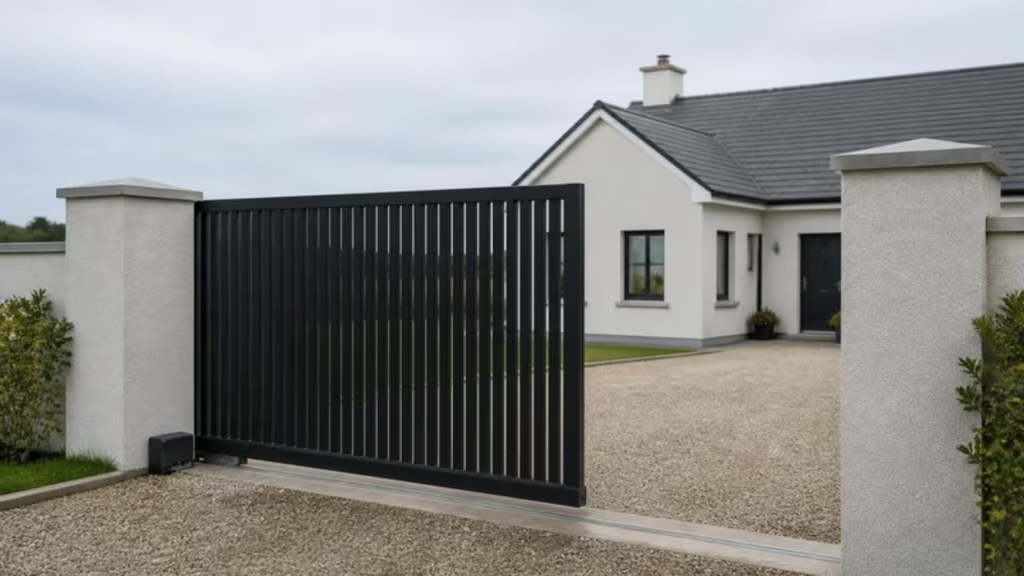
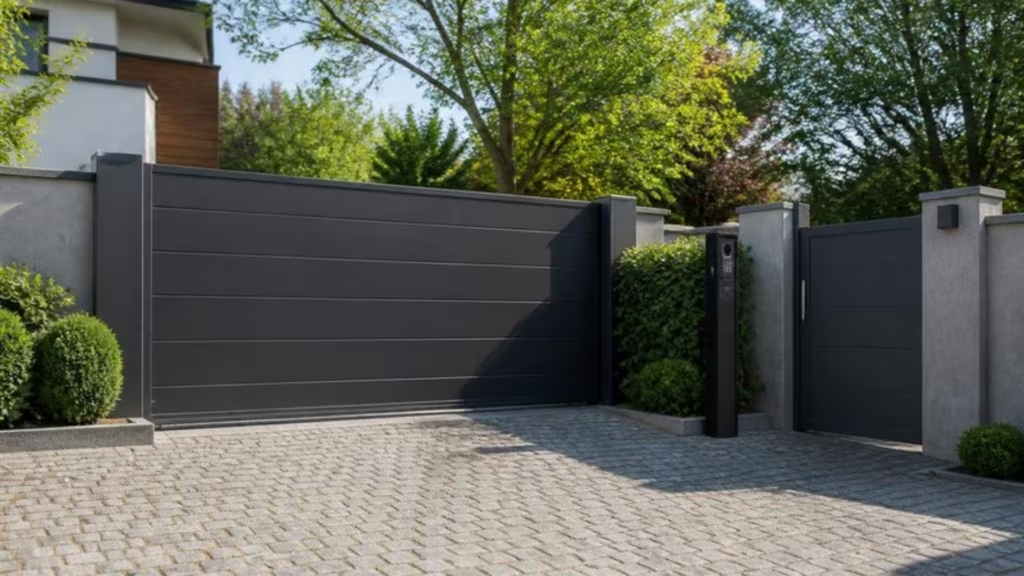
These are illustrations of design ideas, not photos of specific Brega Glazing jobs. See more in our ideas gallery.
Typical uses for electric sliding gates
- Short driveways where a swing gate would hit the car
- Driveways that slope up from the road
- Wide entrances that would need very heavy swing leaves
- Commercial yards and car parks
Electric sliding gate FAQs
How much space does a sliding gate need?
You need clear space along the boundary roughly equal to the width of the opening, so the gate can slide fully open. Cantilever gates need extra length for the counterbalance tail.
Can a sliding gate work on a sloping driveway?
Yes. A sliding gate only needs to be level along the line it slides, across the entrance, so it suits driveways that slope up or down from the road better than swing gates.
Are electric sliding gates safe for children and pets?
When installed properly, with force limitation, photocells and safety edges, they stop and reverse if something is in the way. Still, nobody should play near any automatic gate, and the safety devices should be tested regularly.
How often should an electric gate be serviced?
At least once a year, and more often for heavily used or commercial gates. A service should check and adjust the closing forces and test the safety devices, and include cleaning and lubrication.