
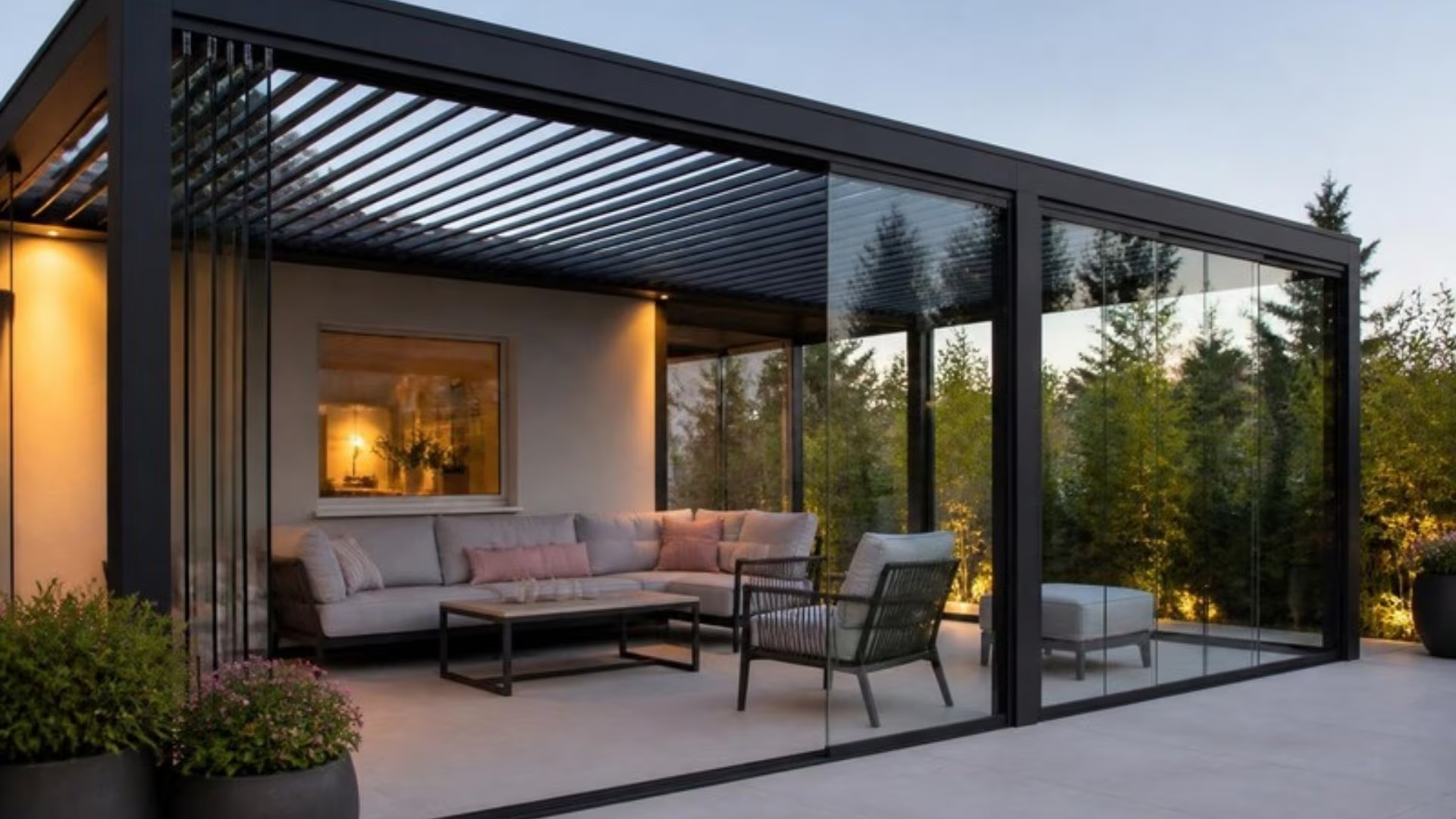
Enclosed pergolas
Add sliding glass or zip screens to the sides of a pergola and it becomes an outdoor room you can use from spring to late autumn.
What is an enclosed pergola?
An enclosed pergola is a pergola with one or more of its open sides closed in. The usual choices are frameless sliding glass panels, vertical zip screens or fixed slatted panels. With the roof closed and the sides drawn across, it blocks wind and rain and holds onto the warmth of a heater. Open everything up again and it’s back to a pergola. In Irish weather, the sides are often what decides whether you use the space in May and September.
Enclosed pergolas at a glance
- Structure: Louvred, glass-roof or fixed-roof aluminium pergola
- Glass sides: Frameless sliding panels in toughened safety glass
- Screen sides: Zip screens: fabric held in side channels, manual or motorised
- Solid sides: Slatted aluminium privacy panels or fixed glass
- Comfort: Infrared heaters and LED lighting
- Use: Three-season outdoor room, not an insulated extension
Choosing the sides
Frameless sliding glass. Panels of toughened glass run in slim top and bottom tracks and stack to one side when open. They block wind and keep the view. They’re not a sealed, insulated wall, so expect some air movement at the joints, but on a breezy evening the difference is huge.
Zip screens. These are fabric blinds whose edges are held in side channels by a zip-like strip, so they stay taut in the wind instead of flapping. They come in shade fabric, insect mesh and blackout, and can be motorised alongside the roof.
Slatted panels. Fixed aluminium slats on the side facing the neighbours, the road or the prevailing wind. They give privacy and shelter but still let air through.
Many enclosed pergolas combine all three: glass facing the garden, a zip screen on the sunny side, and slats on the boundary side.
How we survey, supply and fit enclosed pergolas
- Survey. We check the site, the wind direction and the floor. Sliding glass needs a level base to run well.
- Design. We agree the pergola, the side treatment for each side, and heating and lighting.
- Made to measure. The frame, glass panels, screens and tracks are made to your sizes.
- Installation. We build the pergola, fit the tracks and glass or screens, and adjust everything to run smoothly. A registered electrician connects the electrics.
- Handover. We show you how the sides open, stack and lock.
Planning: when an enclosed pergola becomes an extension
An open pergola in the back garden usually falls under the garden-structure exemption. Once it’s attached to the house and closed in with glass, a council may assess it as an extension instead. That exemption has its own limits, including a maximum of 45 m² for rear extensions since July 2026. Our planning guide explains both sets of rules. If your design is near either limit, it’s worth getting your council’s view first.
Enclosed pergola ideas
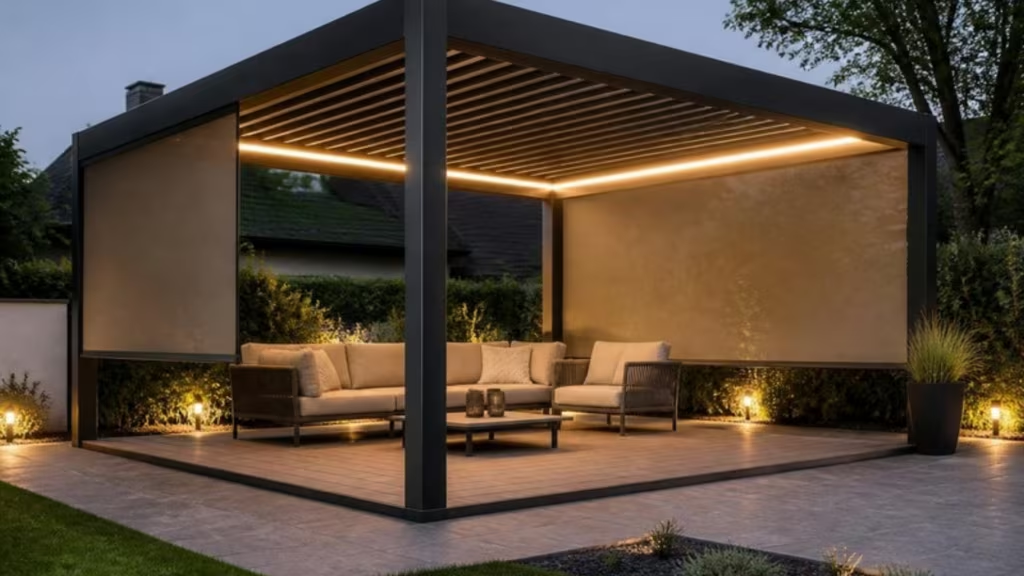
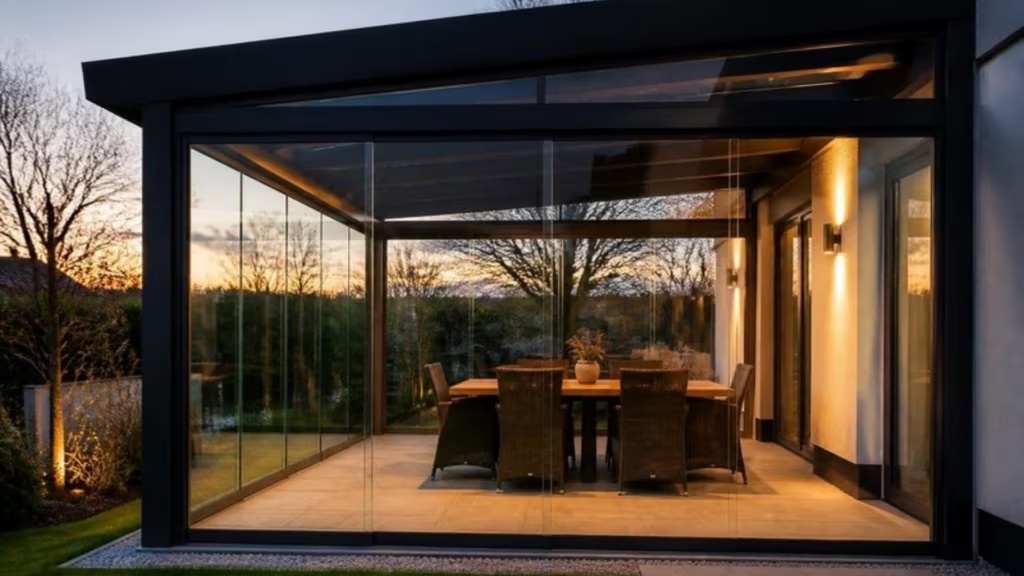
These are illustrations of design ideas, not photos of specific Brega Glazing jobs. See more in our ideas gallery.
Typical uses for enclosed pergolas
- Outdoor dining rooms used well into autumn
- Sheltered hot tub areas
- Home bars and entertaining spaces
- Hospitality terraces that need to block wind
Enclosed pergola FAQs
Can an enclosed pergola be used in winter?
On mild, dry days, with a heater on, yes. It’s designed as a three-season outdoor room, though, not an insulated extension. It blocks wind and rain, but it won’t hold heat like a room in the house. For year-round use, look at a glass room or garden room.
Are frameless glass sides watertight?
They keep out most wind-driven rain, but they aren’t fully sealed. There are small gaps between panels so they can slide. That’s normal for frameless systems. Framed sliding doors seal tighter if that matters more.
What are zip screens?
Zip screens are fabric blinds with edges locked into side channels, so the fabric stays taut and doesn’t flap in the wind. They can be manual or motorised, and come in shade, mesh or blackout fabrics.
Does an enclosed pergola need planning permission?
It depends on how it’s built and where. Open pergolas in the back garden are usually exempt within the garden-structure limits. An attached pergola closed in with glass may be treated as an extension. Check our planning guide and ask your council if you’re unsure.